Your own cloud, full data control, and greater independence: this is what makes Nextcloud attractive to many users and provides a flexible alternative to major public cloud providers.
Veröffentlicht am 1. September 2026 | Lesezeit: 6 Minuten
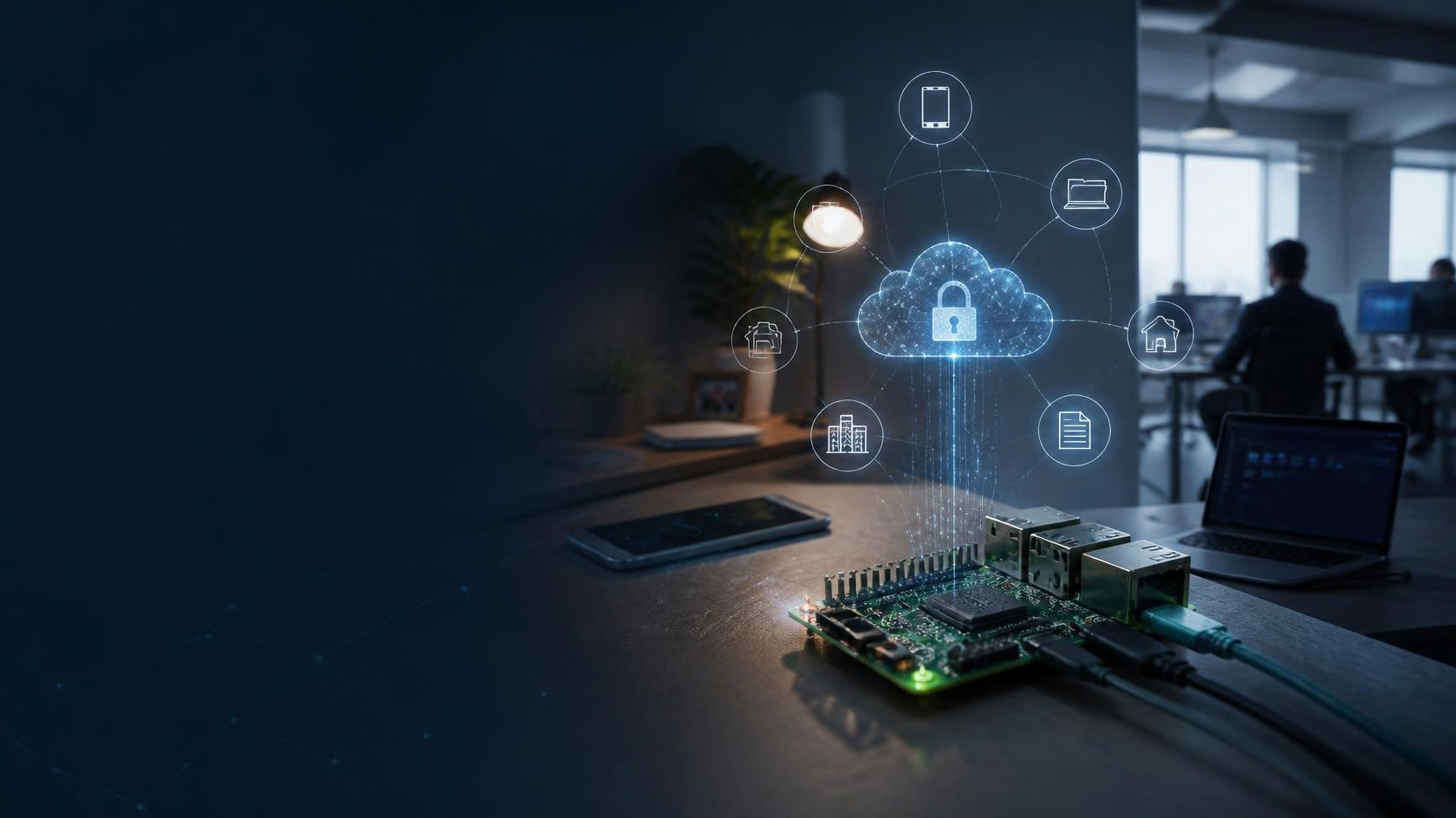
Nextcloud läuft problemlos auf einem Raspberry Pi. Für Unternehmen ist jedoch nicht die Hardware allein entscheidend, sondern Betrieb, Sicherheit, Backups, Monitoring und Verantwortlichkeiten.
Running your own cloud, keeping control of your data, and becoming less dependent on major public cloud providers: these are key reasons why many users are interested in Nextcloud.
The combination of Nextcloud and Raspberry Pi is particularly popular. Search queries like "setting up Nextcloud on Raspberry Pi," "installing Nextcloud on Raspberry Pi," or "Nextcloud on a Raspberry Pi" show just how much interest there is in an affordable, self-hosted cloud.
But what works well for private users presents different requirements for businesses.
Because the crucial question is not just: Can Nextcloud be run on a Raspberry Pi?
But above all: Who will handle reliable, long-term operation?
A Raspberry Pi is compact, energy-efficient, and relatively inexpensive. With a Raspberry Pi 4 or Raspberry Pi 5, a suitable SSD, and the right setup, you can build your own Nextcloud for personal use.
Typical use cases include:
There are several ways to handle the installation. Users can, for example, use NextcloudPi, run Nextcloud with Docker, or perform a classic manual installation.
This type of solution can be particularly appealing to tech-savvy users. You own the hardware, and you have extensive control over your data, configuration, and software.
However, this also means the operator takes on full responsibility for ongoing maintenance.
A Nextcloud setup is more than just a Raspberry Pi with an application installed on it.
For stable and secure long-term operation, various components must be taken into account. These include, among others:
Running Nextcloud on a Raspberry Pi with Docker, for example, provides a flexible deployment option. At the same time, however, containers, images, and the underlying infrastructure must be maintained regularly.
The real challenge is therefore often not the installation, but the long-term operation.
A server can be powered on around the clock. However, that does not automatically mean it is being operated professionally.
For example, what happens when a security update needs to be installed? What happens if a backup fails or storage space runs low?
Other potential issues include:
In a private setting, the answer is usually: the operator takes care of it.
In a business environment, however, it must be clearly defined who is responsible for operations and how to respond to incidents.
This is not just about whether a server is running. What matters are predictable operational processes, defined responsibilities, and reliable recovery in the event of a failure.
A Raspberry Pi can be perfectly adequate for many private applications. Even an SSD can function reliably for a long time.
Nevertheless, any hardware can fail. For a private cloud, an outage lasting several hours or even days might be acceptable. In a business, however, an outage can quickly lead to problems if employees can no longer access important files or work documents.
Therefore, when considering a business solution, you shouldn't just look at the probability of a failure. The decisive question is also:
How quickly can the system be restored in an emergency?
This is where backups and documented recovery processes play a central role.
Simply having a backup is not enough. Businesses should regularly verify that data, configurations, and the required infrastructure can actually be restored reliably.
Monitoring is also essential. Failed backups, running out of storage space, or service outages should be detected before users are affected.
It would be wrong to equate every self-hosted Nextcloud with a Raspberry Pi installation.
In principle, there are different ways to operate Nextcloud.
This option is particularly suitable for private users.
It offers low hardware costs and a high degree of control over your own environment. At the same time, it requires technical know-how and personal responsibility.
For a private cloud, for learning, or for smaller personal projects, this can be a very interesting solution.
Businesses can also run Nextcloud on their own servers or virtual machines.
This can be a professional solution, provided the necessary resources are available. These include, for example:
The decisive difference compared to the Raspberry Pi is not solely in the hardware.
The operating model is much more important.
Even a high-performance server infrastructure must be regularly maintained, monitored, backed up, and restored in the event of a failure.
Another option is a managed Nextcloud.
In this scenario, the company uses Nextcloud as its own cloud platform without having to take on the full technical operation itself.
Depending on the provider and the scope of services, the following tasks can be handled, for example:
This shifts the focus from the question "Which hardware should we use?" to the question:
How do we organize reliable operations?
The differences can be simplified as follows:
A Raspberry Pi offers primary advantages in terms of cost, flexibility, and learning opportunities. A managed Nextcloud, on the other hand, offers advantages when the priority is predictable and professionally organized operation.
For CIOs and IT managers, the decision should not depend solely on the hardware being used.
A Raspberry Pi is inexpensive. A dedicated server can be more powerful. A virtual machine can be scaled flexibly.
However, the central question remains:
Who takes long-term responsibility for the platform?
Even a self-hosted Nextcloud incurs ongoing effort. This includes, among other things, installation, administration, updates, security measures, monitoring, backups, and troubleshooting.
Companies with a suitably equipped IT department can handle these tasks themselves.
For companies that want to focus their IT resources more on internal projects and user support, a managed service model may be a sensible alternative.
Internal labor time is often underestimated when considering the actual costs.
When running your own Nextcloud, you should consider more than just the acquisition costs for a Raspberry Pi or server.
The actual effort includes, for example:
A low-cost hardware solution can therefore still result in significant administrative effort in the long run.
With a managed Nextcloud, on the other hand, there are ongoing costs for the service provided. In return, specific operational tasks can be outsourced to a specialized service provider.
Which option is more economical therefore depends not only on the price of the hardware, but on the total cost of ownership (TCO).
In principle, Nextcloud can be operated on various types of infrastructure. Whether a Raspberry Pi is suitable for a company therefore depends heavily on the specific use case.
For testing, development, training purposes, or smaller internal projects, a Raspberry Pi can certainly be an interesting option.
For a business-critical cloud environment, however, other factors are decisive:
The question should therefore not just be whether the software technically works on the Raspberry Pi.
It is much more important whether the entire environment meets the company's operational requirements.
A professionally hosted Nextcloud can help companies leverage the benefits of their own cloud without having to operate all the technical components themselves.
Depending on requirements and scope of services, the operating concept can include hosting, infrastructure, maintenance, updates, monitoring, and backups, for example.
This can be particularly attractive for companies that want to use Nextcloud but do not want to permanently allocate their own resources for full-scale operation.
The focus is no longer on which server to purchase.
Instead, it is about providing a reliable, predictable, and professionally operated cloud platform.
A Nextcloud on a Raspberry Pi can be an excellent solution.
For private users, the Raspberry Pi offers a cost-effective way to run their own cloud. Whether using NextcloudPi, Docker, or a manual installation, a Raspberry Pi 4 or Raspberry Pi 5 can be used to build a powerful cloud for home use.
For companies, however, the question is different.
Not:
"Can I install Nextcloud myself?"
But:
"How do we ensure long-term operation?"
This includes security, updates, backups, monitoring, maintenance, and reliable recovery in the event of a disruption.
Companies with the necessary resources can host Nextcloud themselves. For organizations looking to reduce administrative overhead and achieve predictable operations, a professionally managed Nextcloud in a data center may be a better choice.
This allows you to combine the benefits of your own Nextcloud with a professional operating model.